
 2 months ago
Prime Video
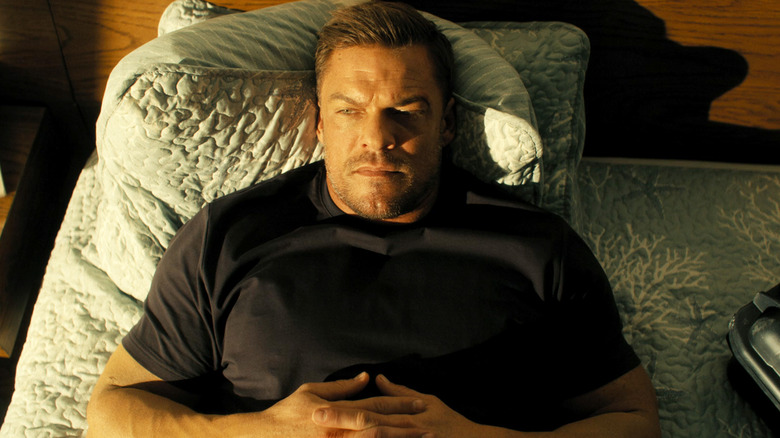
"Reacher" is a show about an unreasonably large man who punches bad guys. That's the essential appeal. Nobody is watching to see some great truths about the human condition revealed, or in-depth character development. At least, nobody is watching to see any character development from Jack Reacher himself. But that doesn't mean those around him can't evolve in their own ways. This is exactly what appealed to director Sam Hill, who helms all of "Reacher" Season 4, after he initially struggled with the literary exploits of Lee Child's ex-military policeman.
Today, the Jack Reacher books comprise 31 novels, a short story collection, a book of "Rules," and even several crossovers, like when Jack Reacher ventured into the world of "Bones" (kind of). Across that expansive bibliography, there's little personal evolution when it comes to the title character. Instead, readers became transfixed thanks to Child's propulsive prose and the fact they could rely on Jack Reacher to remain an unflinching symbol of strength and justice. It's precisely because he doesn't change that Jack Reacher has proved so reliably popular.
Nevertheless, one of the criticisms of Jack Reacher is that he's a so-called Gary Stu: an unrealistically perfect figure who lacks any meaningful flaws or struggles. During a set visit for "Reacher" Season 4 attended by /Film, Hill revealed he initially saw the character in a similar light. "The Reacher figure himself doesn't really arc over any given novel or over any given season," he said, before revealing the secret to his approach. "But it's all the people around him in that orbit who do."
Jack Reacher is the gravity, and everything else is just caught in his orbit
Prime Video
As much as "Reacher" is an absurdly fun piece of pulp entertainment, you'd be hard pressed to argue that Jack Reacher himself undergoes much in terms of character development. That was certainly Sam Hill's experience — at least at first. The director, who oversaw a few episodes of "Reacher" Seasons 1 and 2 before directing all but one episode of the third season, recalled being asked to come on board by showrunner Nick Santora. "I sat down, started reading the Reacher books and the first couple, I was like, 'I don't know, this guy's like just Reacher always, all the time.'"
That is to say, Jack Reacher doesn't undergo much personal evolution. But it soon became clear to Hill why the character might be more interesting than he initially thought. "The deeper you get into it, you start to realize, 'Oh, it's really about these other characters,'" he explained. "By the second cycle through all the novels, I [could] really see what's happening here in a really positive way."
Elaborating on his epiphany, Hill explained how Jack Reacher's lack of character development actually went from a negative to a positive for him, describing it as "one of the things that's the most attractive thing about this project in general." This went on to inform his approach to the series, even down to how scenes were shot, with Hill adding:
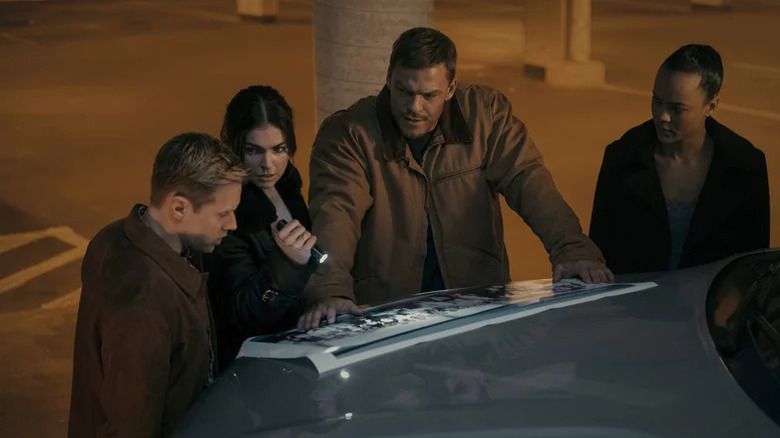
"Reacher is the gravity. He is like the thing that everything rolls into it. He is like the center of all these things. And even how we take things photographically, like the camera always rotates around or gravitates to him and other things happen around him."
Jack Reacher isn't supposed to evolve, and that's okay
Prime Video
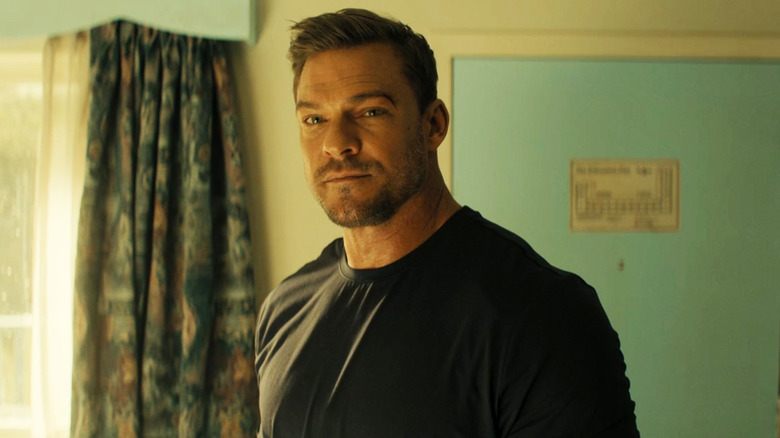
Alan Ritchson has his own problem with action heroes, in that he doesn't like them to appear "invincible." But for Sam Hill, the problem was more complex. That is, until he found his motivation for directing "Reacher" in the idea that characters around the leading man could evolve and adapt as they slid into the Reacher vortex.
With the show being an anthology series, Hill and the team could explore Jack Reacher's character through the reactions and evolutions of the constantly changing cast. As the director put it, "What's new and exciting about every season isn't necessarily like, 'Oh, this person's a bigger, badder person to fight,' or, 'This is a bigger, harder challenge.' It's this whole new group of people reacting to a Reacher perspective on the world." It's an interesting view that adds a new layer to the show, though I'm not sure fans necessarily needed it.
Jack Reacher is a peripatetic hero who wanders the United States righting wrongs and standing up for the little guy. His military background contrasts with his relentlessly individualistic post-military lifestyle, suspending him in a sweet spot between authority and anarchism. Evidently, that's a pretty enticing proposition for readers/viewers, and a big part of why Jack Reacher is so popular. But he's also taking the law into his own hands, arrogating to himself the power to decide right from wrong and stacking the bodies high in the process. That could be a pretty significant moral failing to investigate, but that's not what appeals to fans of Jack Reacher. In that sense, Hill focusing on the peripheral characters is an inspired approach for him, but not necessarily one most fans needed to enjoy the action-fest.


 English (US) ·
  Indonesian (ID) ·